you should spend about 20 minutes on Questions 1-13 which are based on Reading Passage 1 below.
Bricks – The Versatile Building Material
Bricks are one of the oldest known building materials dating back to 7000 BCE. The oldest found were sun- dried mud bricks in southern Turkey and these would have been standard in those days. Although sun-dried mud bricks worked reasonably well, especially in moderate climates, fired bricks were found to be more resistant to harsher weather conditions and so fired bricks are much more reliable for use in permanent buildings. Fired brick are also useful in hotter climates, as they can absorb any heat generated throughout the day and then release it at night.
The Romans also distinguished between the bricks they used that were dried by the sun and air and the bricks that were fired in a kiln. The Romans were real brick connoisseurs. They preferred to make their bricks in the spring and hold on to their bricks for two years, before they were used or sold. They only used clay that was whitish or red for their bricks. The Romans passed on their skills around their sphere of influence and were especially successful at using their mobile kilns to introduce kiln-fired bricks to the whole of the Roman Empire.
During the twelfth century, bricks were introduced to northern Germany from northern Italy. This created the ‘brick Gothic period,’ which was a reduced style of Gothic architecture previously very common in northern Europe. The buildings around this time were mainly built from fired red clay bricks. The brick Gothic period can be categorised by the lack of figural architectural sculptures that had previously been carved in stone, as the Gothic figures were impossible to create out of bulky bricks at that time.
Bricks suffered a setback during the Renaissance and Baroque periods, with exposed brick walls becoming unpopular and brickwork being generally covered by plaster. Only during the mid-eighteenth century did visible brick walls again regain some popularity. Bricks today are more commonly used in the construction of buildings than any other material, except wood. Brick architecture is dominant within its field and a great industry has developed and invested in the manufacture of many different types of bricks of all shapes and colours. With modern machinery, earth moving equipment, powerful electric motors and modern tunnel kilns, making bricks has become much more productive and efficient. Bricks can be made from a variety of materials, the most common being clay, but they can also be made of calcium silicate and concrete.
Good quality bricks have major advantages over stone as they are reliable, weather resistant and can tolerate acids, pollution and fire. They are also much cheaper than cut stonework. Bricks can be made to any specification in colour, size and shape, which makes them easier to build with than stone. On the other hand, there are some bricks that are more porous and therefore more susceptible to damage from dampness when exposed to water. For best results in any construction work, the correct brick must be chosen in accordance with the job specifications.
Today, bricks are mainly manufactured in factories, usually employing one of three principal methods – the soft mud process, the stiff mud process and the dry clay process. In the past, bricks were largely manufactured by hand, and there are still artisanal companies that specialise in this product. The process involves putting the clay, water and additives into a large pit, where it is all mixed together by a tempering wheel, often still moved by horse power. Once the mixture is of the correct consistency, the clay is removed and pressed into moulds by hand. To prevent the brick from sticking to the mould, the brick is coated in either sand or water, though coating a brick with sand gives an overall better finish to it. Once shaped, the bricks are laid outside to dry by air and sun for three to four days. If these bricks left outside for the drying process are exposed to a shower, the water can leave indentations on the brick, which, although not affecting the strength of the brick, is considered very undesirable. After drying, the bricks are then transferred to the kiln for firing and this creates the finished product. Bricks are now more generally made by manufacturing processes using machinery. This is a large-scale effort and produces bricks that have been fired in patent kilns.
Today’s bricks are also specially designed to be efficient at insulation. If their composition is correct and their laying accurate, a good brick wall around a house can save the occupants a significant amount of money. This is primarily achieved today through cavity wall insulation. Insulating bricks are built in two separate leaves, as they are called in the trade. The gap between the inner and outer leaves of brickwork depends on the type of insulation used, but there should be enough space for a gap of twenty millimetres between the insulating material in the cavity and the two leaves on either side. The air in these gaps is an efficient insulator by itself. Cavity walls have also replaced solid walls, because they are more resistant to rain penetration. Because two leaves are necessary, a strong brick manufacturing industry is essential, so that enough good quality insulating bricks are plentifully available.
Can We Hold Back the Flood ?
A LAST winter’s floods on the rivers of central Europe were among the worst since the Middle Ages, and as winter storms return, the spectre of floods is returning too. Just weeks ago, the river Rhône is south-east France burst its banks, driving 15,000 people from their homes, and worse could be on the way. Traditionally, river engineers have gone for Plan A: get rid of the water fast, draining it off the land and down to the sea in tall-sides rivers re-engineered as high-performance drains. But however big they dig city drains, however wide and straight they make the rivers, and however high they build the banks, the floods keep coming back to haunt them, from the Mississippi to the Danube. And when the floods come, they seem to be worse than ever.
B No wonder engineers are turning to Plan B: sap the water’s destructive strength by dispersing it into fields, forgotten lakes, flood plains and aquifers. Back in the days when rivers took a more tortuous path to the sea, floodwaters lost impetus and volume while meandering across flood plains and idling through wetlands and inland deltas. But today the water tends to have an unimpeded journey to the sea. And this means that when it rains in the uplands, the water comes down all at once. Worse, whenever we close off more flood plain, the river’s flow farther downstream becomes more violent and uncontrollable. Dykes are only as good as their weakest link – and the water will unerringly find it.
C Today, the river has lost 7 per cent of its original length and runs up to a third faster. When it rains hard in the Alps, the peak flows from several tributaries coincide in the main river, where once they arrived separately. And with four-fifths of the Lower Rhine’s flood plain barricaded off, the waters rise ever higher. The result is more frequent flooding that does ever-greater damage to the homes, offices and roads that sit on the flood plain. Much the same has happened in the US on the mighty Mississippi, which drains the world’s second- largest river catchment into the Gulf of Mexico.
D The European Union is trying to improve rain forecasts and more accurately model how intense rains swell rivers. That may help cities prepare, but it won’t stop the floods. To do that, say, hydrologists, you need a new approach to engineering, not just Agency – country £1 billion – puts it like this: “The focus is now on working with the forces of nature. Towering concrete walls are out, and new wetlands are in.” to help keep London’s upstream and reflooding 10 square kilometres outside Oxford. Nearer to London it has spent £100 million creating new wetlands and a relief channel across 16 kilometres.
E The same is taking place on a much grander scale in Austria, in one of Europe’s largest river restorations to date. Engineers are regenerating flood plains along 60 kilometres of the river Drave as it exits the Alps. They are also widening the river bed and channeling it back into abandoned meanders, oxbow lakes and backwaters overhung with willows. The engineers calculate that the restored flood plain can now store up to 10 million cubic metres of floodwaters and slow storm surges coming out of the Alps by more than an hour, protecting towns as far downstream as Slovenia and Croatia.
F “Rivers have to be allowed to take more space. They have to be turned from flood-chutes into flood-foilers,” says Nienhuis. And the Dutch, for whom preventing floods is a matter of survival, have gone furthest. A nation built largely on drained marshes and seabed had the fright of its life in 1993 when the Rhine almost overwhelmed it. The same happened again in 1995 when a quarter of a million people were evacuated from the Netherlands. But a new breed of “soft engineers” wants out cities to become porous, and Berlin is their governed by tough new rules to prevent its drains from becoming overloaded after heavy rains. Herald Kraft, an architect working in the city, says: “We now see rainwater as giant Potsdamer Platz, a huge new commercial redevelopment by DaimlerChrysler in the heart of the city.
G Los Angeles has spent billions of dollars digging huge drains and concreting river beds to carry away the water from occasional intense storms. “In LA we receive half the water we need in rainfall, and we throw it away. Then we spend hundreds of millions to import water,” says Andy Lipkis, an LA environmentalist who kick-started the idea of the porous city by showing it could work on one house. Lipkis, along with citizens groups like Friends of the Los Angeles River and Unpaved LA, want to beat the urban flood hazard and fill the taps by holding onto the city’s floodwater. And it’s not just a pipe dream. The authorities this year launched a $100 million scheme to road-test the porous city in one flood-hit community in Sun Valley. The plan is to catch the rain that falls on thousands of driveways, parking lots and rooftops in the valley. Trees will soak up water from parking lots. Homes and public buildings will capture roof water to irrigate gardens and parks. And road drains will empty into old gravel pits and other leaky places that should recharge the city’s underground water reserves. Result: less flooding and more water for the city. Plan B says every city should be porous, every river should have room to flood naturally and every coastline should be left to build its own defences. It sounds expensive and utopian, until you realise how much we spend trying to drain cities and protect our watery margins – and how bad we are at it.
Multitasking Debate
Can you do them at the same time?
A. Talking on the phone while driving isn’t the only situation where we’re worse at multitasking than we might like to think we are. New studies have identified a bottleneck in our brains that some say means we are fundamentally incapable of true multitasking. If experimental findings reflect real-world performance, people who think they are multitasking, are probably just underperforming in all – or at best, all but one – of their parallel pursuits. Practice might improve your performance, but you will never be as good as when focusing on one task at a time.
B. The problem, according to Rene Marois, a psychologist at Vanderbilt University in Nashville, Tennessee, is that there’s a sticking point in the brain. To demonstrate this, Marois devised an experiment to locate it. Volunteers watch a screen and when a particular image appears, a red circle, say, they have to press a key with their index finger. Different coloured circles require presses from different fingers. Typical response time is about half a second, and the volunteers quickly reached their peak performance. Then they learn to listen to different recordings and respond by making a specific sound. For instance, when they hear a bird chirp, they have to say “ba”; an electronic sound should elicit a “ko”, and so on. Again, no problem. A normal person can do that in about half a second, with almost no effort.
C. The trouble comes when Marois shows the volunteers an image, and then almost immediately plays them a sound. Now they’re flummoxed. “If you show an image and play a sound at the same time, one task is postponed,” he says. In fact, if the second task is introduced within the half-second or so it takes to process and react to the first, it will simply be delayed until the first one is done. The largest dual-task delays occur when the two tasks are presented simultaneously; delays progressively shorten as the interval between presenting the tasks lengthens.
D. There are at least three points where we seem to get stuck, says Marois. The first is in simply identifying what we’re looking at. This can take a few tenths of a second, during which time we are not able to see and recognize the second item. This limitation is known as the “attentional blink”: experiments have shown that if you’re watching out for a particular event and a second one shows up unexpectedly any time within this crucial window of concentration, it may register in your visual cortex but you will be unable to act upon it. Interestingly, if you don’t expect the first event, you have no trouble responding to the second. What exactly causes the attentional blink is still a matter for debate.
E. A second limitation is in our short-term visual memory. It’s estimated that we can keep track of about four items at a time, fewer if they are complex. This capacity shortage is thought to explain, in part, our astonishing inability to detect even huge changes in scenes that are otherwise identical, so-called “change blindness”. Show people pairs of near-identical photos – say, aircraft engines in one picture have disappeared in the other – and they will fail to spot the differences. Here again, though, there is disagreement about what the essential limiting factor really is. Does it come down to a dearth of storage capacity, or is it about how much attention a viewer is paying?
F. A third limitation is that choosing a response to a stimulus – braking when you see a child in the road, for instance, or replying when your mother tells you over the phone that she’ s thinking of leaving your dad –also takes brainpower. Selecting a response to one of these things will delay by some tenths of a second your ability to respond to the other. This is called the “response selection bottleneck” theory, first proposed in 1952.
G. But David Meyer, a psychologist at the University of Michigan, Ann Arbor, don’t buy the bottleneck idea. He thinks dual-task interference is just evidence of a strategy used by the brain to prioritise multiple activities. Meyer is known as something of an optimist by his peers. He has written papers with titles like “Virtually perfect time-sharing in dual-task performance: Uncorking the central cognitive bottleneck”. His experiments have shown that with enough practice – at least 2000 tries – some people can execute two tasks simultaneously as competently as if they were doing them one after the other. He suggests that there is a central cognitive processor that coordinates all this and, what’s more, he thinks it uses discretion sometimes it chooses to delay one task while completing another.
H. Marois agrees that practice can sometimes erase interference effects. He has found that with just 1 hour of practice each day for two weeks, volunteers show a huge improvement at managing both his tasks at once. Where he disagrees with Meyer is in what the brain is doing to achieve this. Marois speculates that practice might give us the chance to find less congested circuits to execute a task – rather like finding trusty back streets to avoid heavy traffic on main roads – effectively making our response to the task subconscious. After all, there are plenty of examples of subconscious multitasking that most of us routinely manage: walking and talking, eating and reading, watching TV and folding the laundry.
I. It probably comes as no surprise that, generally speaking, we get worse at multitasking as we age. According to Art Kramer at the University of Illinois at Urbana- Champaign, who studies how ageing affects our cognitive abilities, we speak in our 20s. Though the decline is slow through our 30s and on into our 50s, it is there; and after 55, it becomes more precipitous. In one study, he and his colleagues had both young and old participants do a simulated driving task while carrying on a conversation. He found that while young drivers tended to miss background changes, older drivers failed to notice things that were highly relevant. Likewise, older subjects had more trouble paying attention to the more important parts of a scene than young drivers.
J. It’s not all bad news for over- 55s, though. Kramer also found that older people can benefit from the practice. Not only did they learn to perform better, but brain scans also showed that underlying that improvement was a change in the way their brains become active. While it’s clear that practice can often make a difference, especially as we age, the basic facts remain sobering. “We have this impression of an almighty complex brain,” says Marois, “and yet we have very humbling and crippling limits.” For most of our history, we probably never needed to do more than one thing at a time, he says, and so we haven’t evolved to be able to. Perhaps we will in the future, though. We might yet look back one day on people like Debbie and Alun as ancestors of a new breed of a true multitasker.
Part 1
Questions 1-5
Questions 1-5
Do the following statements agree with the information given in the text? In boxes 1-5 on your answer sheet write:
TRUE if the statement agrees with the information
FALSE if the statement contradicts the information
NOT GIVEN if there is no information on this
Fired bricks are not efficient in countries with hot weather, as they absorb too much heat. 1
Roman brick production was determined by which season it was. 2
The bricks that led to the brick Gothic period in northern Germany were popular with house builders. 3
Buildings showing brickwork were generally not liked during the Renaissance. 4
Some types of bricks can soak up too much water due to their absorbent qualities. 5
Questions 6-13
Questions 6-11
Complete the flow chart below.
Write NO MORE THAN TWO WORDS from the text for each answer.
Write your answers in boxes 6-11 on your answer sheet.
Making Hand-made Bricks
Combine the 6 water and other ingredients with a 7 to the desired consistency.
Using the hand, fill 8
with the mixture-coat with 9
(provides a better finish) or water to prevent stickiness.
Dry in the sun; try to avoid rain, which will cause marks in the bricks – this will no affect the bricks’ 10
. After drying, the bricks are then transferred to the 11
Questions 12 and 13
Label the diagram below.
Write NO MORE THAN TWO WORDS AND/OR A NUMBER from the text for each answer.
Write your answers in boxes 12 and 13 on your answer sheet.
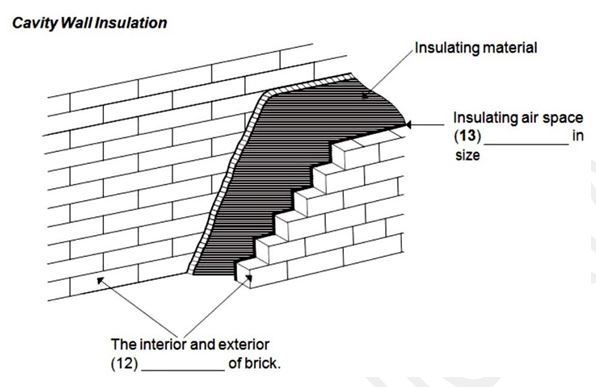
12 13
Part 2
Questions 14-19
Questions 14-19
The Reading Passage has seven paragraphs A-G.
Which paragraph contains the following information?
Write the correct letter A-G, in boxes 1-6 on your answer sheet.
A new approach carried out in the UK. 14
Reasons why the twisty path and dykes failed 15
Illustration of an alternative Plan in LA which seems much unrealistic 16
The traditional way of tackling flood 17
The effort made in the Netherlands and Germany 18
One project on a river benefits three nations 19
Questions 20-24
Questions 20-24
Complete the following summary of the paragraphs of Reading Passage
Using NO MORE THAN TWO WORDS from the Reading Passage for each answer.
Flood makes river shorter than it used to be, which means faster speed and more damage to constructions on a flood plain. Not only European river poses such threat but the same things happens to the powerful 20 in the US. In Europe, one innovative approach carried out by UK’s Environment Agency, for example, a wetland instead of concrete walls in generated not far from the city of 21 to protect it from flooding.
In 1995, Rhine flooded again and thousands of people left the country of 22 A league of engineers suggested that cities should be porous, 23 set a good example for others. Another city devastated by heavy storms casually is 24 though its government pours billions of dollars each year in order to solve the problem.
Questions 25-27
Questions 25-27
Choose THREE correct letters, write your answers in boxes 12-13 on your answer sheet.
What THREE benefits will the new approach in the UK and Austria bring to us according to this passage?
Part 3
Questions 28-32
Questions 28-32
The reading Passage has ten paragraphs A-J.
Which paragraph contains the following information?
Write the correct letter in boxes 28-32 on your answer sheet.
A theory explained delay happens when selecting one reaction 28
Different age group responds to important things differently 29
Conflicts happened when visual and audio element emerge simultaneously 30
An experiment designed to demonstrates the critical part of the brain for multitasking 31
A viewpoint favours the optimistic side of multitasking performance 32
Questions 33-35
Questions 33-35
Choose the correct letter, A, B, C or D.
Write your answers in boxes 33-35 on your answer sheet.
Questions 36-40
Questions 36-40
Do the following statements agree with the information given in Reading Passage 3?
In boxes 36-40 on your answer sheet, write
YES if the statement is true
NO if the statement is false
NOT GIVEN if the information is not given in the passage
The longer gap between the two presenting tasks means a shorter delay toward the second one. 36
Incapable human memory cause people to sometimes miss the differences when presented with two similar images. 37
Marois has a different opinion on the claim that training removes the bottleneck effect. 38
Art Kramer proved there is a correlation between multitasking performance and genders. 39
The author doesn’t believe that the effect of practice could bring any variation 40